


Chaotic behavior can also be found in more general applications
of scalar field dynamics.
Anninos et al. [18] investigated the nonlinear
behavior of colliding kink-antikink solitons or domain walls
described by a single real scalar field with self-interaction
potential  . Domain walls can form
as topological defects during the spontaneous symmetry breaking
period associated with phase transitions, and can seed
density fluctuations in the large scale structure.
For collisional time scales much smaller
than the cosmological expansion, they find that
whether a kink-antikink collision results
in a bound state or a two-soliton solution depends on
a fractal structure observed in the impact velocity parameter space.
The fractal structure arises from a resonance condition
associated with energy exchanges between translational modes
and internal shape-mode oscillations. The impact parameter
space is a complex self-similar fractal composed of sequences
of different n-bounce (the number of bounces or oscillations
in the transient semi-coherent state) reflection windows
separated by regions of oscillating bion states
(see Figure 3).
They compute the Lyapunov exponents for parameters in which
a bound state forms to
demonstrate the chaotic nature of the bion oscillations.
. Domain walls can form
as topological defects during the spontaneous symmetry breaking
period associated with phase transitions, and can seed
density fluctuations in the large scale structure.
For collisional time scales much smaller
than the cosmological expansion, they find that
whether a kink-antikink collision results
in a bound state or a two-soliton solution depends on
a fractal structure observed in the impact velocity parameter space.
The fractal structure arises from a resonance condition
associated with energy exchanges between translational modes
and internal shape-mode oscillations. The impact parameter
space is a complex self-similar fractal composed of sequences
of different n-bounce (the number of bounces or oscillations
in the transient semi-coherent state) reflection windows
separated by regions of oscillating bion states
(see Figure 3).
They compute the Lyapunov exponents for parameters in which
a bound state forms to
demonstrate the chaotic nature of the bion oscillations.
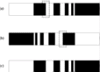 scalar field potential. The top image (a) shows the 2-bounce
windows in dark with the rightmost region (v/c > 0.25)
representing the single-bounce regime above which no captured
state exists, and the leftmost white region (v/c < 0.19)
representing the captured state below which no reflection windows
exist. Between these two marker velocities, there are 2-bounce
reflection states of decreasing widths separated by regions of
bion formation. Zooming in on the domain outlined by the dashed
box, a self-similar structure is apparent in the middle image (b),
where now the dark regions represent 3-bounce windows of
decreasing widths. Zooming in once again on the boundaries of
these 3-bounce windows, a similar structure is found as shown in
the bottom image (c) but with 4-bounce reflection windows. This
pattern of self-similarity with n-bounce windows is observed at
all scales investigated numerically.
scalar field potential. The top image (a) shows the 2-bounce
windows in dark with the rightmost region (v/c > 0.25)
representing the single-bounce regime above which no captured
state exists, and the leftmost white region (v/c < 0.19)
representing the captured state below which no reflection windows
exist. Between these two marker velocities, there are 2-bounce
reflection states of decreasing widths separated by regions of
bion formation. Zooming in on the domain outlined by the dashed
box, a self-similar structure is apparent in the middle image (b),
where now the dark regions represent 3-bounce windows of
decreasing widths. Zooming in once again on the boundaries of
these 3-bounce windows, a similar structure is found as shown in
the bottom image (c) but with 4-bounce reflection windows. This
pattern of self-similarity with n-bounce windows is observed at
all scales investigated numerically.

|
Computational Cosmology: from the Early Universe to the Large Scale Structure Peter Anninos http://www.livingreviews.org/lrr-2001-2 © Max-Planck-Gesellschaft. ISSN 1433-8351 Problems/Comments to livrev@aei-potsdam.mpg.de |