


 as an effective isotropic pressure in the stress-energy tensor

The matter source terms can then be written

with  .
.

where R is the scalar Riemann curvature,  is the interaction
potential,
is the interaction
potential,  is typically assumed to be
  ,
and
,
and  is the field-curvature coupling constant
(
is the field-curvature coupling constant
(  for minimally coupled fields and
  for
conformally coupled fields).
Varying the action yields the Klein-Gordon equation
for
conformally coupled fields).
Varying the action yields the Klein-Gordon equation
for the scalar field and

for the stress-energy tensor, where  .
.
For a massive, minimally coupled scalar field [41]

and

where
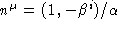 ,
and is a general potential which, for example,
can be set to
,
and is a general potential which, for example,
can be set to  in the chaotic inflation model.
The covariant form of the scalar field equation (27
in the chaotic inflation model.
The covariant form of the scalar field equation (27 )
can be expanded as in [86] to yield
)
can be expanded as in [86] to yield

which, when coupled to (33), determines the
evolution of the scalar field.
where m is the rest mass of the particles, n is the number density
in the comoving frame, and  is the 4-velocity of each particle.
The matter source terms are
is the 4-velocity of each particle.
The matter source terms are

There are two conservation laws: the conservation of particles
 ,
and the conservation of energy-momentum
,
and the conservation of energy-momentum
 ,
where
,
where  is the covariant derivative in the full 4-dimensional
spacetime.
Together these conservation laws lead to
is the covariant derivative in the full 4-dimensional
spacetime.
Together these conservation laws lead to
 ,
the geodesic equations of motion for the particles, which can be
written out more explicitly in the
computationally convenient form
,
the geodesic equations of motion for the particles, which can be
written out more explicitly in the
computationally convenient form

where  is the coordinate position of each particle,
 is determined by the normalization
  ,
,

is the Lagrangian derivative, and
 is the ``transport'' velocity
of the particles as measured by
observers at rest with respect to the coordinate grid.
is the ``transport'' velocity
of the particles as measured by
observers at rest with respect to the coordinate grid.
where  is the 4-metric,
 is the relativistic enthalpy,
and
is the relativistic enthalpy,
and  , P,
, P,  and
and  are the specific internal
energy (per unit mass), pressure, rest mass density and four-velocity
of the fluid. Defining
are the specific internal
energy (per unit mass), pressure, rest mass density and four-velocity
of the fluid. Defining
as the generalization of the special relativistic boost factor, the matter source terms become

The hydrodynamics equations are derived from the
normalization of the 4-velocity, ,
the conservation of baryon number,  ,
and the conservation of energy-momentum, .
The resulting equations can be written in flux conservative
form as [126
,
and the conservation of energy-momentum, .
The resulting equations can be written in flux conservative
form as [126 ]
]
where  ,
,  ,
,  ,
,
 ,
,  ,
and g is the determinant of the 4-metric satisfying
,
and g is the determinant of the 4-metric satisfying
 .
A prescription for specifying an equation of state
(e.g.,
.
A prescription for specifying an equation of state
(e.g.,  for an ideal gas)
completes the above equations.
for an ideal gas)
completes the above equations.
When solving
equations (47, 48, 49),
an artificial viscosity method is needed
to handle the formation and propagation of shock
fronts [126, 72, 73]. Although these
methods are simple to implement and are computationally
efficient, they are inaccurate for ultrarelativistic
flows with very high Lorentz factors.
On the other hand, a number of different
formulations [67]
of these equations have been developed to
take advantage of the hyperbolic and
conservative nature of the equations in using high resolution
shock capturing schemes (although strict conservation is only possible
in flat spacetimes - curved spacetimes exhibit source terms due to
geometry).
Such high resolution Godunov techniques [107, 24]
provide more accurate and stable treatments
in the highly relativistic regime.
A particular formulation due to [24] is the following:
where

and
 ,
,
 ,
,
 ,
,
 ,
,
 ,
,
 ,
and
,
and
 .
.

|
Computational Cosmology: from the Early Universe to the Large Scale Structure Peter Anninos http://www.livingreviews.org/lrr-2001-2 © Max-Planck-Gesellschaft. ISSN 1433-8351 Problems/Comments to livrev@aei-potsdam.mpg.de |


