 |
 |
 |
|
|
|
Equilibrium states in galactic dynamics can be described as stationary solutions of the Einstein–Vlasov system, or of the Vlasov–Poisson system in the Newtonian case. Here we will consider the former case for which only static, spherically symmetric solutions have been constructed, but we mention that in the latter case also, stationary axially symmetric solutions have been found by Rein [85].
In the static, spherically symmetric case, the problem can be formulated as follows. Let the spacetime metric have the form

where  ,
, ![θ ∈ [0,π ]](article428x.gif) ,
, ![ϕ ∈ [0,2π]](article429x.gif) . As before, asymptotic flatness is expressed by the boundary
conditions
. As before, asymptotic flatness is expressed by the boundary
conditions

and a regular centre requires

Following the notation in Section 2.1, the time-independent Einstein–Vlasov system reads
The matter quantities are defined as before: The quantities
are conserved along characteristics.  is the particle energy and
  is the angular momentum squared. If
we let
is the angular momentum squared. If
we let

for some function  , the Vlasov equation is automatically satisfied. The form of
  is usually restricted
to
is usually restricted
to
 and
and  . If
. If  ,
,  , for some positive constant
  , this is
called the polytropic ansatz. The case of isotropic pressure is obtained by letting
, this is
called the polytropic ansatz. The case of isotropic pressure is obtained by letting  so that
  only
depends on
only
depends on  . We refer to [81
 ] for information on the role of
  .
.
In passing, we mention that for the Vlasov–Poisson system it has been shown [15] that every static
spherically symmetric solution must have the form  . This is referred to as Jeans’ theorem. It
was an open question for some time to decide whether or not this was also true for the Einstein–Vlasov
system. This was settled in 1999 by Schaeffer [107], who found solutions that do not have this particular
form globally on phase space, and consequently, Jeans’ theorem is not valid in the relativistic case.
However, almost all results in this field rest on this ansatz. By inserting the ansatz for
. This is referred to as Jeans’ theorem. It
was an open question for some time to decide whether or not this was also true for the Einstein–Vlasov
system. This was settled in 1999 by Schaeffer [107], who found solutions that do not have this particular
form globally on phase space, and consequently, Jeans’ theorem is not valid in the relativistic case.
However, almost all results in this field rest on this ansatz. By inserting the ansatz for  in
the matter quantities
in
the matter quantities  and
and  , a nonlinear system for
  and
and  is obtained, in which

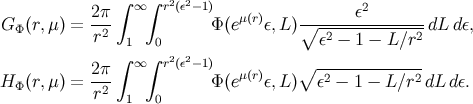
Existence of solutions to this system was first proved in the case of isotropic pressure in [90] and then
extended to the general case in [81]. The main problem is then to show that the resulting solutions have
finite (ADM) mass and compact support. This is accomplished in [90] for a polytropic ansatz with isotropic
pressure and in [81] for a polytropic ansatz with possible anisotropic pressure. They use a
perturbation argument based on the fact that the Vlasov–Poisson system is the limit of the
Einstein–Vlasov system as the speed of light tends to infinity [89]. Two types of solutions are
constructed, those with a regular centre [90, 81], and those with a Schwarzschild singularity in the
centre [81]. In [91] Rendall and Rein go beyond the polytropic ansatz and assume that  satisfies

where  ,
,  ,
,  ,
,  . They show that this assumption is sufficient
for obtaining steady states with finite mass and compact support. The result is obtained in a more
direct way and is not based on the perturbation argument mentioned above. Their method is
inspired by a work on stellar models by Makino [67], in which he considers steady states of
the Euler–Einstein system. In [91] there is also an interesting discussion about steady states
that appear in the astrophysics literature. They show that their result applies to most of these
steady states, which proves that they have the desirable property of finite mass and compact
support.
. They show that this assumption is sufficient
for obtaining steady states with finite mass and compact support. The result is obtained in a more
direct way and is not based on the perturbation argument mentioned above. Their method is
inspired by a work on stellar models by Makino [67], in which he considers steady states of
the Euler–Einstein system. In [91] there is also an interesting discussion about steady states
that appear in the astrophysics literature. They show that their result applies to most of these
steady states, which proves that they have the desirable property of finite mass and compact
support.
All solutions described so far have the property that the support of  contains a ball about the centre.
In [84] Rein shows that there exist steady states whose support is a finite, spherically symmetric shell, so
that they have a vacuum region in the centre.
contains a ball about the centre.
In [84] Rein shows that there exist steady states whose support is a finite, spherically symmetric shell, so
that they have a vacuum region in the centre.
At present, there are almost no known results concerning the stability properties of the steady states to the Einstein–Vlasov system. In the Vlasov–Poisson case, however, the nonlinear stability of stationary solutions has been investigated by Guo and Rein [51] using the energy-Casimir method. In the Einstein–Vlasov case, Wolansky [121] has applied the energy-Casimir method and obtained some insights but the theory in this case is much less developed than in the Vlasov–Poisson case and the stability problem is essentially open.
|
|
|
| http://www.livingreviews.org/lrr-2005-2 |
© Max Planck Society and the author(s)
Problems/comments to |


