


 seconds after the
Big Bang, before which the classical description of general relativity
is expected to give way to a quantum theory of gravity.
At the earliest times, the Universe was a plasma of
relativistic particles consisting of quarks, leptons,
gauge bosons, and Higgs bosons represented by
scalar fields with interaction and symmetry regulating potentials.
It is believed that several spontaneous
symmetry breaking (SSB) phase transitions occured in
the early Universe as it expanded and cooled,
including the grand unification
transition (GUT) at seconds
after the Big Bang in which the strong nuclear force split off
from the weak and electromagnetic forces (this also marks an era
of inflationary expansion and the
origin of matter-antimatter asymmetry through baryon,
charge conjugation, and charge + parity violating interactions
and nonequilibrium effects); the electroweak (EW)
SSB transition at
seconds after the
Big Bang, before which the classical description of general relativity
is expected to give way to a quantum theory of gravity.
At the earliest times, the Universe was a plasma of
relativistic particles consisting of quarks, leptons,
gauge bosons, and Higgs bosons represented by
scalar fields with interaction and symmetry regulating potentials.
It is believed that several spontaneous
symmetry breaking (SSB) phase transitions occured in
the early Universe as it expanded and cooled,
including the grand unification
transition (GUT) at seconds
after the Big Bang in which the strong nuclear force split off
from the weak and electromagnetic forces (this also marks an era
of inflationary expansion and the
origin of matter-antimatter asymmetry through baryon,
charge conjugation, and charge + parity violating interactions
and nonequilibrium effects); the electroweak (EW)
SSB transition at  s when the weak nuclear
force split from the electromagnetic force; and the chiral or quantum
chromodynamic (QCD)
symmetry breaking transition at
s when the weak nuclear
force split from the electromagnetic force; and the chiral or quantum
chromodynamic (QCD)
symmetry breaking transition at  s during which
quarks condensed into hadrons. The most stable hadrons (baryons,
or protons and neutrons comprised of three quarks) survived the
subsequent period of baryon-antibaryon annihilations, which
continued until the Universe cooled to the point at which
new baryon-antibaryon pairs could no longer be produced. This resulted
in a large number of photons and relatively few surviving baryons.
A period of primordial nucleosynthesis followed from
s during which
quarks condensed into hadrons. The most stable hadrons (baryons,
or protons and neutrons comprised of three quarks) survived the
subsequent period of baryon-antibaryon annihilations, which
continued until the Universe cooled to the point at which
new baryon-antibaryon pairs could no longer be produced. This resulted
in a large number of photons and relatively few surviving baryons.
A period of primordial nucleosynthesis followed from
 to
to  s during which light element
abundances were synthesized to form 24% helium with trace amounts of
deuterium, tritium, helium-3, and lithium.
s during which light element
abundances were synthesized to form 24% helium with trace amounts of
deuterium, tritium, helium-3, and lithium.
By  s, the matter density became equal to the
radiation density as the Universe continued to
expand, identifying the start of
the current matter-dominated
era and the beginning of structure formation.
Later, at
s, the matter density became equal to the
radiation density as the Universe continued to
expand, identifying the start of
the current matter-dominated
era and the beginning of structure formation.
Later, at  s (
s (  years),
the free ions and electrons combined to form atoms,
effectively decoupling the matter from the radiation field as
the Universe cooled. This decoupling
or post-recombination epoch
marks the surface of last scattering and the boundary
of the observable (via photons) Universe.
Assuming a hierarchical Cold Dark Matter (CDM) structure formation
scenario, the subsequent development
of our Universe is characterized by the
growth of structures with increasing size. For example,
the first stars are likely to have formed at
years),
the free ions and electrons combined to form atoms,
effectively decoupling the matter from the radiation field as
the Universe cooled. This decoupling
or post-recombination epoch
marks the surface of last scattering and the boundary
of the observable (via photons) Universe.
Assuming a hierarchical Cold Dark Matter (CDM) structure formation
scenario, the subsequent development
of our Universe is characterized by the
growth of structures with increasing size. For example,
the first stars are likely to have formed at  years
from molecular gas clouds when the Jeans mass of the
background baryonic fluid was approximately
years
from molecular gas clouds when the Jeans mass of the
background baryonic fluid was approximately  ,
as indicated in Figure 1.
This epoch of pop III star generation is followed by the formation
of galaxies at
,
as indicated in Figure 1.
This epoch of pop III star generation is followed by the formation
of galaxies at  years and subsequently galaxy clusters.
Though somewhat controversial, estimates of the current
age of our Universe range from 10 to 20 Gyrs, with
a present-day linear structure scale radius of about
years and subsequently galaxy clusters.
Though somewhat controversial, estimates of the current
age of our Universe range from 10 to 20 Gyrs, with
a present-day linear structure scale radius of about
 Megaparsecs, where h is the Hubble
parameter (compared to 2-3 Megaparsecs
typical for the virial radius of rich galaxy clusters).
Megaparsecs, where h is the Hubble
parameter (compared to 2-3 Megaparsecs
typical for the virial radius of rich galaxy clusters).

 to the
current time. A residual ionization fraction of
to the
current time. A residual ionization fraction of
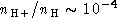 following recombination allows
for Compton interactions with photons to
following recombination allows
for Compton interactions with photons to  , during which
the Jeans mass remains constant at
, during which
the Jeans mass remains constant at  . The Jeans
mass then decreases as the Universe expands adiabatically until
the first collapsed structures form sufficient amounts of hydrogen
molecules to trigger a cooling instability and produce pop III
stars at
. The Jeans
mass then decreases as the Universe expands adiabatically until
the first collapsed structures form sufficient amounts of hydrogen
molecules to trigger a cooling instability and produce pop III
stars at  . Star formation activity can then reheat the
Universe and raise the mean Jeans mass to above
. Star formation activity can then reheat the
Universe and raise the mean Jeans mass to above
 . This reheating could affect the subsequent
development of structures such as galaxies and the observed
Lyman-alpha clouds.
. This reheating could affect the subsequent
development of structures such as galaxies and the observed
Lyman-alpha clouds.

|
Computational Cosmology: from the Early Universe to the Large Scale Structure Peter Anninos http://www.livingreviews.org/lrr-2001-2 © Max-Planck-Gesellschaft. ISSN 1433-8351 Problems/Comments to livrev@aei-potsdam.mpg.de |