

where

and  for open, flat and closed Universes.
Also,
for open, flat and closed Universes.
Also,  is the
cosmological scale factor, z is the redshift, and
is the
cosmological scale factor, z is the redshift, and  is the
comoving inhomogeneous gravitational potential.
is the
comoving inhomogeneous gravitational potential.
The governing equations in the Newtonian limit are the hydrodynamic conservation equations,
the geodesic equations for collisionless dust or dark matter (in comoving coordinates),


Poisson's equation for the gravitational potential,

and the Friedman equation for the cosmological scale factor,

Here  ,
,  ,
,  and
and
 are the dark matter density, baryonic density, pressure
and internal energy density in the proper reference frame,
are the dark matter density, baryonic density, pressure
and internal energy density in the proper reference frame,  and
and
 are the baryonic comoving coordinates and peculiar
velocities,
are the baryonic comoving coordinates and peculiar
velocities,  and
and  are the dark matter
comoving coordinates and peculiar velocities,
are the dark matter
comoving coordinates and peculiar velocities,
 is the proper background
density of the Universe,
is the proper background
density of the Universe,  is the total density parameter,
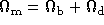 is the density
parameter including both baryonic and dark matter contributions,
is the density
parameter including both baryonic and dark matter contributions,
 is the density parameter
attributed to the cosmological constant
is the density parameter
attributed to the cosmological constant  ,
,
 is the present Hubble
constant with 0.5<h<1, and
is the present Hubble
constant with 0.5<h<1, and  represents
microphysical radiative cooling and heating rates which can include
Compton cooling (or heating) due to interactions of free electrons
with the CMBR, bremsstrahlung, and atomic and molecular line
cooling. Notice that `tilded' (`non-tilded') variables refer to
proper (comoving) reference frame attributes.
represents
microphysical radiative cooling and heating rates which can include
Compton cooling (or heating) due to interactions of free electrons
with the CMBR, bremsstrahlung, and atomic and molecular line
cooling. Notice that `tilded' (`non-tilded') variables refer to
proper (comoving) reference frame attributes.
An alternative total energy conservative form of the hydrodynamics equations that allows high resolution Godunov-type shock capturing techniques is
with the corresponding particle and gravity equations



where  is the comoving density,
 ,
,
 is the proper frame peculiar velocity,
p is the comoving
pressure,
is the proper frame peculiar velocity,
p is the comoving
pressure,  is the
total peculiar energy per comoving volume, and
is the
total peculiar energy per comoving volume, and  is the
gravitational potential.
is the
gravitational potential.
These equations are easily extended [19 ] to include
reactive chemistry of nine separate atomic and molecular species
(H, H
] to include
reactive chemistry of nine separate atomic and molecular species
(H, H  , He, He , He
  , H
, H  , H
, H  , H
, H  , and e ),
assuming a common flow field, supplementing the
total mass conservation equation (58
, and e ),
assuming a common flow field, supplementing the
total mass conservation equation (58
for each of the species,
and including the effects of non-equilibrium radiative cooling
and consistent coupling to the hydrodynamics equations.
The  are rate coefficients for the two body reactions
and are tabulated functions of the gas temperature T.
The
are rate coefficients for the two body reactions
and are tabulated functions of the gas temperature T.
The  are integrals evaluating the
photoionization and photodissociation of the different species.
For a comprehensive discussion of the cosmologically
important chemical reactions and reaction rates,
see reference [1]
.
are integrals evaluating the
photoionization and photodissociation of the different species.
For a comprehensive discussion of the cosmologically
important chemical reactions and reaction rates,
see reference [1]
.
Many numerical techniques have been developed to
solve the hydrodynamic and collisionless particle equations.
For the hydrodynamic equations, the methods range from
Lagrangian SPH algorithms [64, 76, 103] to
Eulerian finite difference
techniques on static meshes [110, 104],
nested grids [17], moving
meshes [70], and adaptive mesh refinement [47].
For the dark matter equations, the canonical choices are
treecodes [123] or
PM and P  M methods [78, 62], although many variants
have been developed to optimize computational performance
and accuracy,
including grid and particle refinement methods
(see references cited in [68]).
An efficient method for solving non-equilibrium, multi-species
chemical reactive flows together with the hydrodynamic equations
in a background FLRW model is described in [1, 19].
M methods [78, 62], although many variants
have been developed to optimize computational performance
and accuracy,
including grid and particle refinement methods
(see references cited in [68]).
An efficient method for solving non-equilibrium, multi-species
chemical reactive flows together with the hydrodynamic equations
in a background FLRW model is described in [1, 19].
The reader is referred to [83, 68]
for thorough comparisons of different numerical methods applied
to problems of structure formation. Reference [83]
compares (by binning data at different
resolutions) the statistical
performance of five codes (three Eulerian and two SPH)
on the problem of an evolving CDM Universe on large scales
using the same initial data. The results indicate that global
averages of physical attributes converge in rebinned
data, but that some uncertainties remain at small levels.
[68] compares
twelve Lagrangian and Eulerian hydrodynamics
codes to resolve the formation of a single X-ray cluster in a CDM
Universe. The study finds generally good agreement for both
dynamical and thermodynamical quantities, but also shows
significant differences in the X-ray luminosity, a quantity
that is especially sensitive to resolution [15].
where the complex phases are chosen from a gaussian random field,
T(k) is a transfer function [25]
appropriate to a particular
structure formation scenario (e.g., CDM), and
n=1 corresponds to the Harrison-Zel'dovich power spectrum.
The fluctuations are normalized with top hat smoothing using
where b is the bias factor chosen to match present observations
of rms density fluctuations in a spherical window of radius
 Mpc. Also,
P(k) is the Fourier transform of the
square of the density fluctuations in equation (72
Mpc. Also,
P(k) is the Fourier transform of the
square of the density fluctuations in equation (72 ), and

is the Fourier transform of a spherical window of radius  .
.
Overdensity peaks can be filtered on specified spatial or mass scales by Gaussian smoothing the random density field [25]

on a comoving scale  centered at
  (for example,
  Mpc with a filtered mass of
 over cluster scales).
 peaks are generated by
sampling different random field realizations to satisfy the condition
peaks are generated by
sampling different random field realizations to satisfy the condition
 ,
where
,
where  is the rms of Gaussian filtered density
fluctuations over a spherical volume of radius .
is the rms of Gaussian filtered density
fluctuations over a spherical volume of radius .
Bertschinger [40] has provided a useful and publicly available package of programs called COSMICS for computing transfer functions, CMB anisotropies, and gaussian random initial conditions for numerical structure formation calculations. The package solves the coupled linearized Einstein, Boltzman, and fluid equations for scalar metric perturbations, photons, neutrinos, baryons, and collisionless dark matter in a background isotropic Universe. It also generates constrained or unconstrained matter distributions over arbitrarily specifiable spatial or mass scales.

|
Computational Cosmology: from the Early Universe to the Large Scale Structure Peter Anninos http://www.livingreviews.org/lrr-2001-2 © Max-Planck-Gesellschaft. ISSN 1433-8351 Problems/Comments to livrev@aei-potsdam.mpg.de |








