


 ,
due to the gravitational redshifting of the
photons through the Sachs-Wolfe effect arising from potential
gradients [111, 13
,
due to the gravitational redshifting of the
photons through the Sachs-Wolfe effect arising from potential
gradients [111, 13 ]
]

where the integral is evaluated from the emission (e)
to reception (r) points along the spatial photon paths
 ,
,  is the gravitational potential,
 defines the temperature fluctuations,
and a(t) is the cosmological scale factor in the standard FLRW metric.
Also, if the intergalactic medium (IGM)
reionizes sometime after the decoupling,
say from an early generation of stars, the increased
rate of Thomson scattering off the
free electrons will erase sub-horizon scale
temperature anisotropies, while creating secondary
Doppler shift anisotropies.
To make meaningful comparisons between numerical models
and observed data, these effects
(and others, see for example § 4.1.3
and references [79
defines the temperature fluctuations,
and a(t) is the cosmological scale factor in the standard FLRW metric.
Also, if the intergalactic medium (IGM)
reionizes sometime after the decoupling,
say from an early generation of stars, the increased
rate of Thomson scattering off the
free electrons will erase sub-horizon scale
temperature anisotropies, while creating secondary
Doppler shift anisotropies.
To make meaningful comparisons between numerical models
and observed data, these effects
(and others, see for example § 4.1.3
and references [79 , 82]) must be
incorporated self-consistently
into the numerical models and to high accuracy
in order to resolve the weak signals.
, 82]) must be
incorporated self-consistently
into the numerical models and to high accuracy
in order to resolve the weak signals.
]).
Although such linearized approaches yield reasonable
results, they are not well-suited to discussing the expected
imaging of the developing nonlinear structures in the
microwave background.
An alternative ray-tracing approach has been developed by
Anninos et al. [13] to introduce and propagate
individual photons through the evolving nonlinear matter
structures. They solve the geodesic equations of motion
and subject the photons to Thomson
scattering in a probabilistic way
and at a rate determined by the
local density of free electrons in the model.
Since the temperature fluctuations remain small,
the equations of motion for the photons are treated
as in the linearized limit, and the anisotropies are
computed according to

where

and the photon wave vector  and
matter rest frame four-velocity
and
matter rest frame four-velocity  are
evaluated at the emission (e) and reception (r) points.
Applying their procedure to a Hot Dark Matter (HDM) model
of structure formation,
Anninos et al. [13] find the parameters
for this model are severely constrained by COBE data
such that
are
evaluated at the emission (e) and reception (r) points.
Applying their procedure to a Hot Dark Matter (HDM) model
of structure formation,
Anninos et al. [13] find the parameters
for this model are severely constrained by COBE data
such that  ,
where
,
where  and h are the density and Hubble
parameters.
and h are the density and Hubble
parameters.
 and h=0.55,
which produces CMBR anisotropies above current COBE limits
when no reionization is included (see § 4.1.1),
they find that the
EG scenario effectively reduces the anisotropies
to the levels observed by COBE and generates smaller
Doppler shift anisotropies than the LS model, as demonstrated
in Figure 4.
The LS scenario of reionization is not able to reduce
the anisotropy levels below the COBE limits,
and can even give rise to greater Doppler shifts
than expected at decoupling.
and h=0.55,
which produces CMBR anisotropies above current COBE limits
when no reionization is included (see § 4.1.1),
they find that the
EG scenario effectively reduces the anisotropies
to the levels observed by COBE and generates smaller
Doppler shift anisotropies than the LS model, as demonstrated
in Figure 4.
The LS scenario of reionization is not able to reduce
the anisotropy levels below the COBE limits,
and can even give rise to greater Doppler shifts
than expected at decoupling.
 ) due to the Sachs-Wolfe effect and Doppler
shifts in a standard critically closed HDM model with no
reionization and baryon fractions 0.02 (plate 1:
) due to the Sachs-Wolfe effect and Doppler
shifts in a standard critically closed HDM model with no
reionization and baryon fractions 0.02 (plate 1:
 , rms
, rms  ) and 0.2
(plate 2:
) and 0.2
(plate 2:  , rms
, rms
 ). The bottom two plates image fluctuations in an
``early and gradual'' reionization scenario of decaying neutrinos
with baryon fraction 0.02 (plate 3: , rms
). The bottom two plates image fluctuations in an
``early and gradual'' reionization scenario of decaying neutrinos
with baryon fraction 0.02 (plate 3: , rms
 ; and plate 4: , rms
 ).
). Cold Dark Matter (CDM) models,
focusing on the relative importance of secondary
temperature anisotropies due to three different effects:
1) time-dependent variations
in the gravitational potential
of nonlinear structures as a result of collapse
or expansion (the Rees-Sciama effect);
2) proper motion of nonlinear structures
such as clusters and superclusters across the sky;
and 3) the decaying gravitational potential
effect from the evolution of perturbations in open models.
They applied the ray-tracing procedure of [13] to
explore the relative importance of these secondary
anisotropies as a function of
the density parameter and
the scale of matter distributions.
They find that secondary temperature anisotropies are
dominated by the decaying potential effect at large scales,
but that all three sources of anisotropy can produce signatures
of order
Cold Dark Matter (CDM) models,
focusing on the relative importance of secondary
temperature anisotropies due to three different effects:
1) time-dependent variations
in the gravitational potential
of nonlinear structures as a result of collapse
or expansion (the Rees-Sciama effect);
2) proper motion of nonlinear structures
such as clusters and superclusters across the sky;
and 3) the decaying gravitational potential
effect from the evolution of perturbations in open models.
They applied the ray-tracing procedure of [13] to
explore the relative importance of these secondary
anisotropies as a function of
the density parameter and
the scale of matter distributions.
They find that secondary temperature anisotropies are
dominated by the decaying potential effect at large scales,
but that all three sources of anisotropy can produce signatures
of order  as shown in Figure 5.
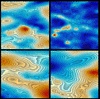
 , though the open
model carries a somewhat larger signature.
, though the open
model carries a somewhat larger signature.
In addition to the effects discussed here, many other sources of secondary anisotropies (such as gravitational lensing, the Vishniac effect accounting for matter velocities and flows into local potential wells, and the Sunyaev-Zel'dovich (§ 4.5.4) distortions from the Compton scattering of CMB photons by electrons in the hot cluster medium) can also be significant. See reference [79] for a more complete list and thorough discussion of the different sources of CMBR anisotropies.

|
Computational Cosmology: from the Early Universe to the Large Scale Structure Peter Anninos http://www.livingreviews.org/lrr-2001-2 © Max-Planck-Gesellschaft. ISSN 1433-8351 Problems/Comments to livrev@aei-potsdam.mpg.de |