


 factorization
The generalized (GRQ) factorization of an  -by-
-by- matrix
  and
a
and
a  -by- matrix
  is given by the pair of factorizations

where  and
and  are respectively -by- and -by- orthogonal
matrices (or unitary matrices if and are complex).
are respectively -by- and -by- orthogonal
matrices (or unitary matrices if and are complex).
 has the form

or

where  or
or  is upper triangular.
  has the form

or

where  is upper triangular.
Note that if is square and nonsingular, the GRQ factorization of
and implicitly gives the factorization of the matrix  :
:

without explicitly computing the matrix inverse  or the product
.
or the product
.
The routine xGGRQF computes the GRQ factorization
by first computing the factorization of and then
the  factorization of
  .
The orthogonal (or unitary) matrices and
can either be formed explicitly or
just used to multiply another given matrix in the same way as the
orthogonal (or unitary) matrix
in the factorization
(see section 2.3.2).
.
The orthogonal (or unitary) matrices and
can either be formed explicitly or
just used to multiply another given matrix in the same way as the
orthogonal (or unitary) matrix
in the factorization
(see section 2.3.2).
The GRQ factorization can be used to solve the linear
equality-constrained least squares problem (LSE) (see (2.2) and
[page 567]GVL2).
We use the GRQ factorization of and (note that and have
swapped roles), written as

We write the linear equality constraints  as:
as:

which we partition as:

Therefore  is the solution of the upper triangular system

Furthermore,

We partition this expression as:

where 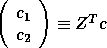 , which
can be computed by xORMQR (or xUNMQR).
, which
can be computed by xORMQR (or xUNMQR).
To solve the LSE problem, we set

which gives  as the solution of the upper triangular system

Finally, the desired solution is given by

which can be computed by xORMRQ (or xUNMRQ).