


An  -by-
-by- band matrix with
  subdiagonals
and
subdiagonals
and  superdiagonals may be
stored compactly in a two-dimensional array with
superdiagonals may be
stored compactly in a two-dimensional array with  rows and columns.
Columns of the matrix are stored in corresponding columns of the
array, and diagonals of the matrix are stored in rows of the array.
This storage scheme should be used in practice only if
rows and columns.
Columns of the matrix are stored in corresponding columns of the
array, and diagonals of the matrix are stored in rows of the array.
This storage scheme should be used in practice only if  ,
although LAPACK routines work correctly for all values of and .
In LAPACK, arrays that hold matrices in band storage have names
ending in `B'.
,
although LAPACK routines work correctly for all values of and .
In LAPACK, arrays that hold matrices in band storage have names
ending in `B'.
To be precise,  is stored in AB(
 ) for
) for
 .
For example, when
.
For example, when  ,
,  and
and  :
:
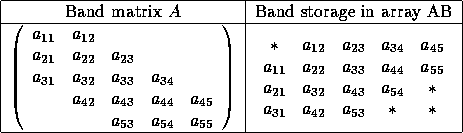
The elements marked  in the upper left and lower right
corners of the array AB need not be set, and are not referenced by
LAPACK routines.
in the upper left and lower right
corners of the array AB need not be set, and are not referenced by
LAPACK routines.
Note: when a band matrix is supplied for  factorization,
space must be allowed to store an
additional superdiagonals,
generated by fill-in as a result of row interchanges.
This means that the matrix is stored according to the above scheme,
but with
factorization,
space must be allowed to store an
additional superdiagonals,
generated by fill-in as a result of row interchanges.
This means that the matrix is stored according to the above scheme,
but with  superdiagonals.
Triangular band matrices are stored in the same format, with either
 if upper triangular, or
  if
lower triangular.
if
lower triangular.
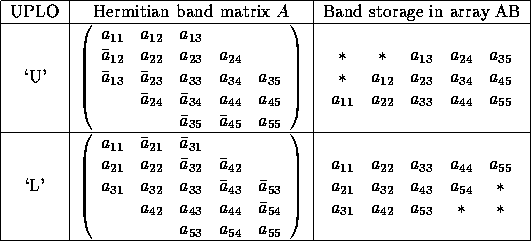
For symmetric or Hermitian band matrices with  subdiagonals or
superdiagonals, only the upper or lower triangle (as specified by
UPLO) need be stored:
subdiagonals or
superdiagonals, only the upper or lower triangle (as specified by
UPLO) need be stored:
is stored in AB( ) for
) for
 ;
;
is stored in AB( ) for
) for
 .
.
For example, when  and
and  :
:
EISPACK routines use a different storage scheme for band matrices, in which rows of the matrix are stored in corresponding rows of the array, and diagonals of the matrix are stored in columns of the array (see Appendix D).