
\mathrm{log} a
Note: Using the font selector \rm provided by LATEX 2.09 will not work in math mode.
We can process all standard inline and single display style equation environments like
| $ …$ | \begin{displaymath} | $$ | \begin{equation} |
| \( …\) | … | … | … |
| \[ …\] | \end{displaymath} | $$ | \end{equation} |
However, to let the Living Reviews popup equation referencing system work properly we cannot permit the following environments:
| \begin{subequations} | \begin{eqaligntwo} |
| … | … |
| \end{subequations} | \end{eqaligntwo} |
It is not allowed to use the \label command inside of an eqnarray* or an equation* environment (i.e. in the versions of the respective environments which suppress equation numbers). When such a label is referenced, this will lead to inserting wrong reference marks in the print as well as the onscreen versions of the article.
Equations within text paragraphs,  ,
,  , are bracketed like that: $ y = x^2 $ or \(
\sqrt{a^2 - b^2} \).
, are bracketed like that: $ y = x^2 $ or \(
\sqrt{a^2 - b^2} \).
If they are displayed, i.e. separated from the text,
![[( ) ] x2 ---− 1 + sin2 𝜃 = lnx, n](LivRevRel3x.gif)
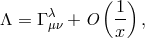
use
which generates equations without numbering, while
displays equations numbers.
We recommend to use the LATEX display style for separated equations
and text style for inline equations like  :
:
$ x / y = \int_a^b x dr $. This can also be enforced by \displaystyle and \textstyle
resp.
 |
 |
 |
|
Living Rev. Relativity 16, (2013), 1
http://www.livingreviews.org/LivRevRelTemplate |

This work is licensed under a Creative Commons License. E-mail us: |

